QPM Introduces the Pipelines Feature

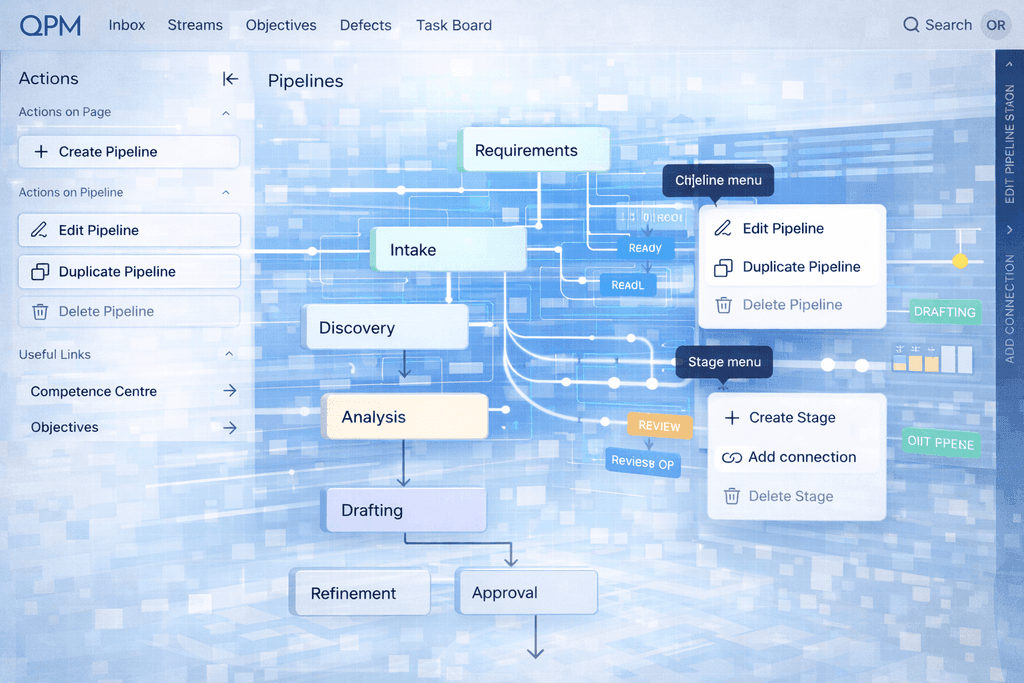
Recurring processes are a familiar reality for any team. Feature development, character creation in a game, release launches, marketing campaigns—the structure of the work often remains the same, only the details change.
That is why we introduced a new Pipelines feature for reusing and scaling typical processes through Pipeline Templates.
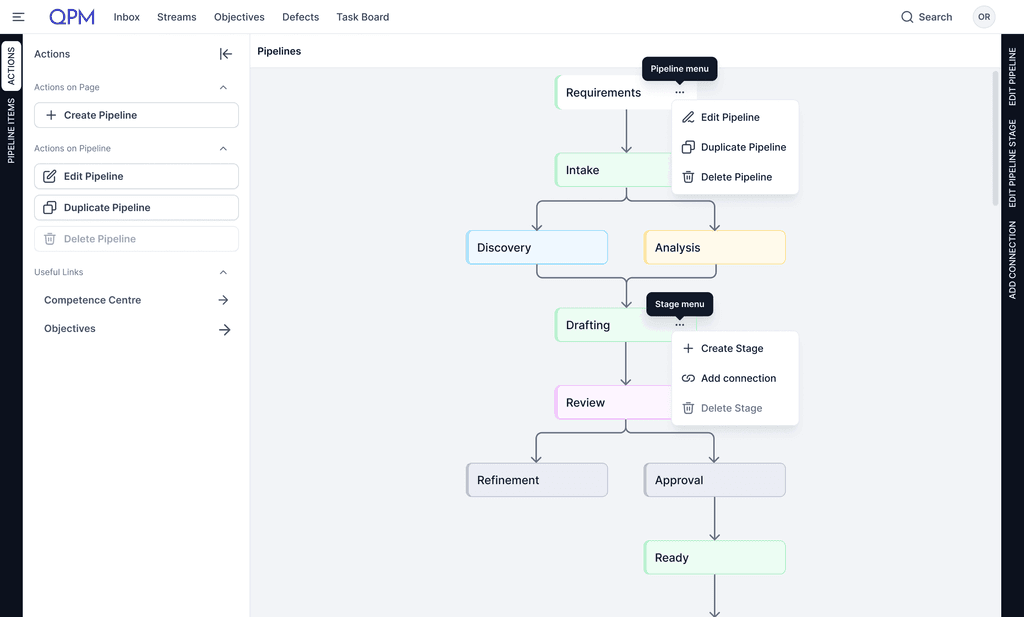
Pipelines allow you to create standardized process templates with a defined sequence of stages, the required competencies of performers, effort estimates, and dependency logic. Instead of manually decomposing the same tasks each time, the team can set up the right process model once and reuse it for new goals (Objectives).
After a Pipeline is linked to an Objective, the system automatically generates a complete set of tasks with an already defined execution structure. The process logic, dependencies, and skill requirements are preserved without additional configuration.
Who Benefits Most from This Feature
Product Managers gain a reliable way to launch recurring initiatives without risking process consistency across releases.
Project Managers can significantly reduce planning time and avoid common errors associated with manual task decomposition.
Team Leads benefit from stable execution logic and predictable workload distribution aligned with team competencies.
CTOs and technical leaders can standardize development processes and scale them across teams without sacrificing control.
Bug Tracking & Quality Control — Manage issues and ensure standards with ease
Resource Management & Performance Monitoring — Gain full visibility over team capacity and output
Seamless Integrations — Connect effortlessly with GitHub, GitLab, Azure DevOps, OneDrive, Google Drive, and more
What Pipelines in QPM Give to Businesses
Time savings in configuring recurring processes
Pipelines allow you to configure the execution logic of a typical process once and reuse it repeatedly. Teams no longer spend time manually creating identical task chains — the structure, dependencies, and requirements are already embedded in the template. This significantly reduces operational workload and accelerates the launch of new initiatives.Flexible adaptation to change
The business environment changes rapidly, and processes must keep pace. Pipelines make it possible to quickly update a template — adding new stages, modifying required competencies, or adjusting dependency logic. Once updated, the model can be easily scaled to new Objectives without compromising the integrity of the process.Reduced operational risks
Maintaining clearly defined dependencies between stages minimizes chaos during team restructuring or growth. Even in complex multi-layered processes, the execution structure remains predictable. This reduces the risk of disrupting the work sequence, overloading resources, or losing critical steps.Increased productivity through automation
Automating routine actions frees managers from the technical decomposition of tasks, allowing them to focus on strategic decisions. The team works not on “creating structure,” but on delivering real business value.Synchronization of team collaboration
A single standardized execution sequence ensures transparency and predictability in cross-departmental collaboration. All participants understand which stage the process is currently in, which competencies are involved, and what steps come next. This builds a culture of coordinated work without unnecessary approvals.Scalability without loss of quality
A single configured Pipeline can be applied to dozens or even hundreds of similar units of work. This allows a company to scale its operations without increasing managerial complexity and without compromising quality standards.Pipelines in QPM are not just a standardization tool. This is a mechanism for systematic growth that transforms recurring processes into a controlled, predictable, and scalable model for business development.
A detailed description of the Pipelines feature is available at https://www.qpm.ai/en/features/pipelines