Bug & Defect Tracking
A structured approach to handling product defects
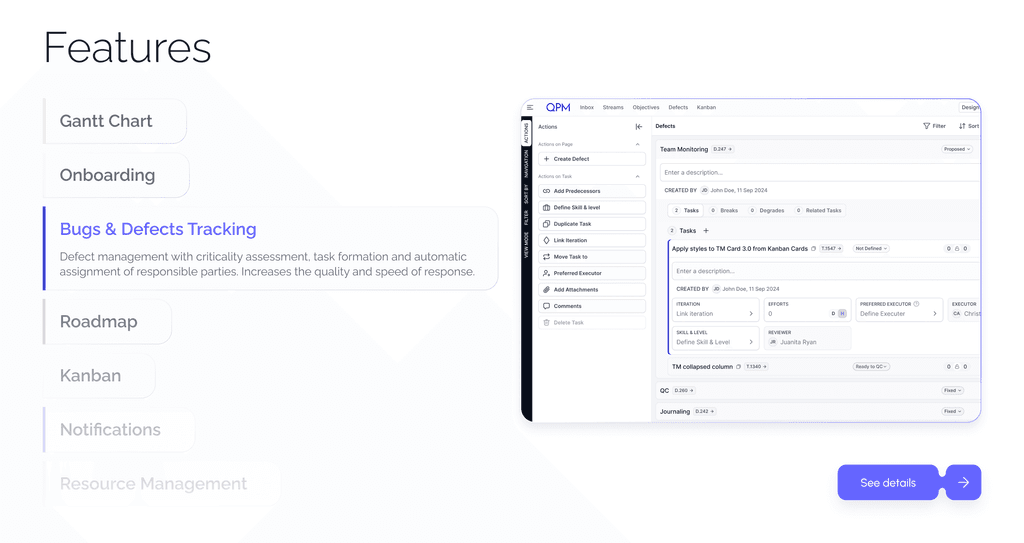
A dedicated defect model lets you accurately determine the criticality of an issue—whether it breaks functionality and blocks the product, or is a minor mismatch with expectations, such as a visual inconsistency or a non-blocking behavioral glitch. The system logs the defect, identifies its impact on the Objective, assigns priority, and generates the required tasks for resolution, ensuring a fully controlled and transparent process.


Who benefits from Bug & Defect Tracking

Product Managers / Product Owners
For PM/PO roles, a Defect is a standalone product entity that can be evaluated by criticality (Breaks / Degrade) and its impact on an Objective. This allows much more precise prioritization: some defects can be added to the current sprint, while others can be scheduled for future iterations.

Project Managers
The feature helps PMs clearly see all defects separately from tasks and understand which of them pose real risks to the release. This enables better workload management and data-driven decisions on urgency, rather than relying on scattered ad hoc reports.

Team Leads (Dev, QA, Design)
Leads get a clear structure: some bugs are tied to tasks, while others exist as standalone Defects that impact product functionality. This makes it easier to assign ownership, assess complexity, and prevent critical defects from being lost among minor bugs.

Developers
Dev teams see well-structured Defects with context, related tasks, and priorities — eliminating confusion between a minor bug inside a task and an actual systemic issue. This speeds up delivery and reduces the risk of misunderstandings.

QA Team
Testers can create Defects as a separate model, set their criticality, link related tasks, and manage the full lifecycle until complete resolution. This preserves product quality and provides significantly more transparency than traditional “bugs attached to tasks.”
Stakeholders & Business
They get a clear view of which defects break key functionality and which are purely cosmetic. This supports informed decisions on releases, postponements, and resource allocation for fixes.
Key features
A Defect exists as an independent entity in the system, separate from tasks, with its own lifecycle and links to Objectives and Tasks.
Learn more about QPM
How Bug & Defect Tracking Works
A QA team member or any team member logs the defect not as a bug within a task, but as an independent product model. Upon creation, the Defect automatically receives the status Proposed.
Why Use Defect Model Management

Structure instead of chaos

Risk-based prioritization

Execution control

Convenient planning

Improved product quality
Learn more about QPM